

The mission of the Shrine is to promote devotion to St. Vincent Ferrer and, in imitation of the life of St. Vincent Ferrer, to utilize preaching and the reception of the sacraments for the salvation of souls, in accord with the spiritual traditions of the Order of Preachers. It is meant to be a place for pilgrims to show their devotion to this saint known for his many miracles, especially through veneration of the first-class relics of the saint.
Prayers are remembered during our monthly devotion on First Fridays.
Novena Prayer to St. Vincent Ferrer
O glorious apostle and worker of miracles, St. Vincent Ferrer, a new Angel of the Apocalypse and our kind protector, receive our humble prayers and obtain for us a copious shower of divine favors (pray for your intention). By that love with which thy heart was inflamed, obtain for us from the Father of mercies the pardon of all our sins, confirmation in the faith, and perseverance in good works; so that living as good and fervent Christians, we may become worthy of thy powerful patronage. Extend thy patronage also to our bodies, and free us from our infirmities. Protect our lands from the violence of tempest and hail, and keep misfortune far from us. Thus, blessed by thee in the goods of the soul and body, we shall be ever devoted to thee, and one day see thee in heaven, there with thee to praise God forever and ever. Amen.
(Indulgenced Prayer, Pope Leo XIII; September 17, 1887)
-
May Jesus, Son of Mary, Master and Salvation of the world, who has brought you to the Catholic faith, keep you therein, and render you happy: and may He deign, through the merits of the Blessed Virgin Mary, of our Blessed Father St. Dominic, and of all the Saints, to deliver you of the infirmity which overwhelms you. In the name of the Father, and of the Son, and of the Holy Spirit. Amen.
-
Lord, have mercy on us.
Christ, have mercy on us.
Lord, have mercy on us.
Christ, hear us.
Christ, graciously hear us.
God, the Father of heaven,
have mercy on us.
God the Son, Redeemer of the world,
have mercy on us.
God the Holy Ghost,
have mercy on us.
Holy Trinity, one God,
have mercy on us.Holy Mary, pray for us.
Holy Mary, Queen of the Most Holy Rosary, *
St. Dominic, our august Father, *
St. Vincent Ferrer,
St. Vincent, glory of Valencia, *
St. Vincent, lily of purity, *
St. Vincent, miracle of piety from childhood, *
St. Vincent, interpreter of the Holy Trinity, *
St. Vincent, pearl of virginity, *
St. Vincent, burning light of charity, *
St. Vincent, mirror of penance, *
St. Vincent, trumpet of eternal salvation, *
St. Vincent, flower of heavenly wisdom, *
St. Vincent, preacher of the Holy Gospel, *
St. Vincent, powerful in work and word, *
St. Vincent, apostle of the universe, *
St. Vincent, prophet of Christ, Who is to come, *
St. Vincent, most devout to the Mother of God, *
St. Vincent, ever most pious, *
St. Vincent, most fervent reconciler of souls, *
St. Vincent, most bountiful to the poor, *
St. Vincent, most learned teacher, *
St. Vincent, most holy preacher, *
St. Vincent, most firm under every temptation, *
St. Vincent, most illustrious by miracles, *
St. Vincent, cherished by Jesus Christ, *
St. Vincent, most addicted to prayer, *
St. Vincent, burning for the salvation of souls, *
St. Vincent, true model of humility, *
St. Vincent, confessor filled with knowledge, *
St. Vincent, most powerful reviver of the dead. *
St. Vincent, lover of the faith of God, *
St. Vincent, health of the sick, *
St. Vincent, support of the holy faith, *
St. Vincent, master of penitents, *
St. Vincent, refuge of the afflicted, *
St. Vincent, star of those who hope in God, *
St. Vincent, brightness of the elect, *
St. Vincent, conqueror of devils, *
St. Vincent, companion of angels, *
St. Vincent, treasure of virtue, *
St. Vincent, sight of the blind, *
St. Vincent, hearing of the deaf, *
St. Vincent, speech of the dumb, *
St. Vincent, consolation of the desolate, *
St. Vincent, who wears in heaven the double crown of virginity and doctorate, *
St. Vincent, immortal glory of the Order of Preachers, *
St. Vincent, powerful protector of those who invoke thy aid, *
St. Vincent, protector of those who invoke thee, *We sinners beseech thee hear us.
That thou wouldst vouchsafe to obtain for us an increase of faith and devotion;
we beseech thee hear us. **
That through thy merits, we may be made participators of eternal beatitude; **
That through thy holy prayers, we may obtain the pardon of our sins; **
That through thy holy intercession, we may merit to become true children of Mary; **
That through thee, we may be delivered from all evils of soul and body; **
That thou wouldst vouchsafe to obtain for us before death a true repentance and **
That thou wouldst vouchsafe to intercede for us; **
Lamb of God, Who takest away the sins of the world:
spare us, O Lord.
Lamb of God, Who takest away the sins of the world:
graciously hear us, O Lord.
Lamb of God, Who takest away the sins of the world:
have mercy on us, O Lord.V. St. Vincent Ferrer, pray for us.
R. That we may be made worthy of the promises of Christ.Let us pray:
O God, Who by the salutary preaching of Blessed Vincent, Thy confessor, didst mercifully call the multitude of the people to the ardor of Thy love and to the fear of the terrible judgment, grant, we beseech Thee, that through his merits and intercession, we may stand secure at that awful judgment, and enjoy Thy promises in eternal beatitude. Through Christ our Lord. Amen.
Inside the Church of
St. Vincent Ferrer and the National Shrine
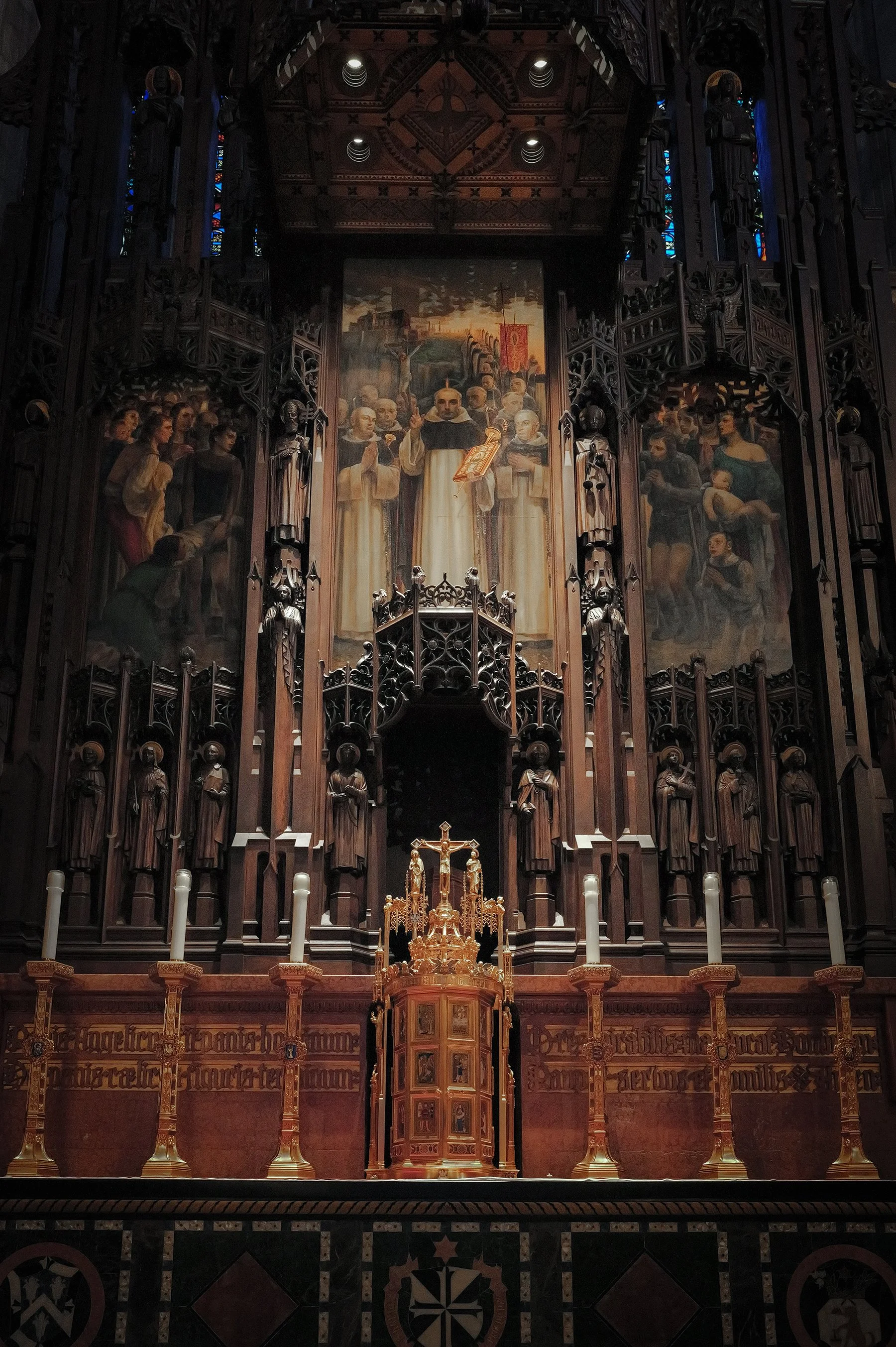
Above the High Altar in the Church of St. Vincent Ferrer is what is known as the “triptych,” or three-paneled painting depicting the miracles of St. Vincent Ferrer. The patron saint is clearly visible standing at the head of a long procession of Dominican friars. The procession is seen coming from a church pictured on a hill, a symbol of the heavenly Jerusalem. The church is a miniature painting of the Church of St. Vincent Ferrer.
In the painting, the saint can be seen bearing in his hands his symbols—a trumpet of judgment and a book. On the right side, the sick and afflicted men and women await the touch of the hand of God’s wonder-worker. On the left, a group begs St. Vincent to perform one of his greatest miracles, the restoration of a dead man to life.
Above the High Altar are the windows of the sanctuary. The great East or Main Window is the “Window of the Last Judgment,” founded on the vision of St. John as recorded in the Book of Revelation (the Apocalypse). St. Vincent Ferrer, the “Preacher of the Judgment,” likened himself to the Angel of the Judgment foretold in the Apocalypse of St. John. Thus, he is the central figure, holding a trumpet, with the Seventh Angel of the Apocalypse pictured behind him. The theme of this whole magnificent window is based on eight chapters of Revelation: 1, 4, 5, 6, 8, 9, 12, and 19.
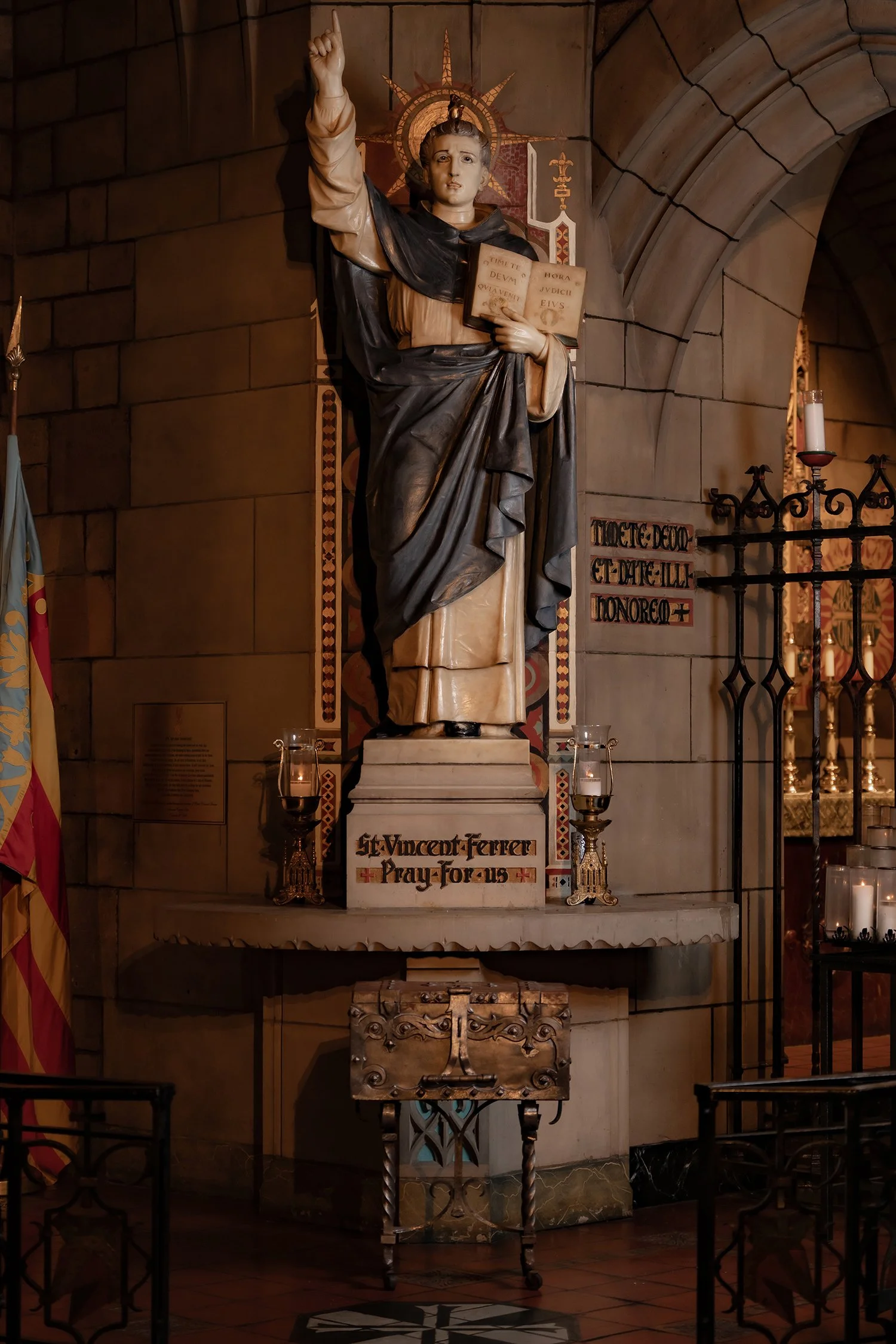
In the body of the church, occupying a commanding point of view, is the National Shrine of St. Vincent Ferrer. The marble statue represents him preaching. He wears the cappa, the black preaching cloak of the Dominican Order. His hand is upraised, and the flame of the Holy Spirit is depicted above him. The Trumpet of the Judgment, a symbol of this Preacher of the Judgment, is seen on the right of the iron rail that encloses the Shrine. The burden of his preaching is engraved in the brightly illuminated book he carried: Timete Deum quia venit hora judicii ejus (“Fear God, for the hour of his judgment is coming” – Revelation 14:7). This is the text on which he preached so often. To the right, engraved in stone: Timete Deum et date illi honorem (“Fear God and give him honor” – Revelation 14:7). Beneath his statue is the inscription: “St. Vincent Ferrer, pray for us.”
The Miracle Bell
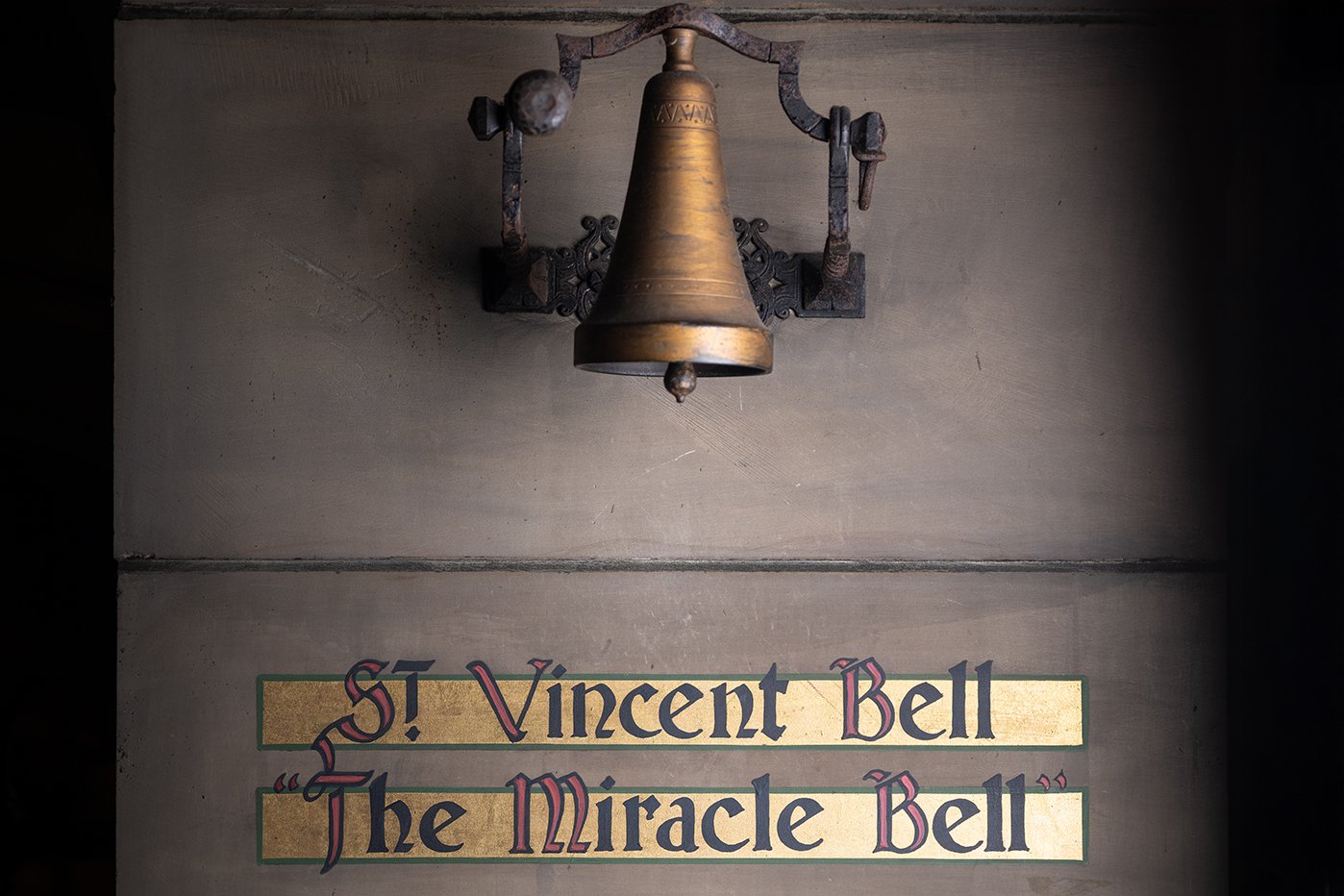
The Miracle Bell hangs to the right of the Shrine. It was rung daily at the services held in honor of the saint. It is placed there as a reminder that it was St. Vincent Ferrer’s custom to use a bell to call the people of the town together. These gatherings in the evenings were accompanied by astounding miracles. Historical evidence shows that at these gatherings, St. Vincent Ferrer would cure the lame, the sick, the dying, and raise the dead to life. He would deliver those possessed by evil spirits. All the afflictions and miseries of humankind, distress and disease, moral evils, and even death itself disappeared at the saint’s touch.
Since the erection of this Shrine, St. Vincent Ferrer, still the sympathetic lover of the poor and afflicted, has performed countless wonders on the bodies and souls of those who call upon his help.
The Life of
St. Vincent Ferrer
Born: January 23, 1350, in Valencia, Spain
Entered the Order of Preachers: February 5, 1367
Ordained to the Priesthood: 1379
Died: April 5, 1419, aged 69, in Vannes, Duchy of Brittany
Canonized: June 3, 1455 by Pope Callixtus III
Feast Day: April 5 (Roman Calendar) | May 5 (Dominican Calendar)
Attributes: Trumpet and Book of Judgment
Motto: Timete Deum et date illi honorem: quia venit hora judicii ejus. (Fear God and give him honor, for the hour of his judgement is coming.) (Revelation 14:7)
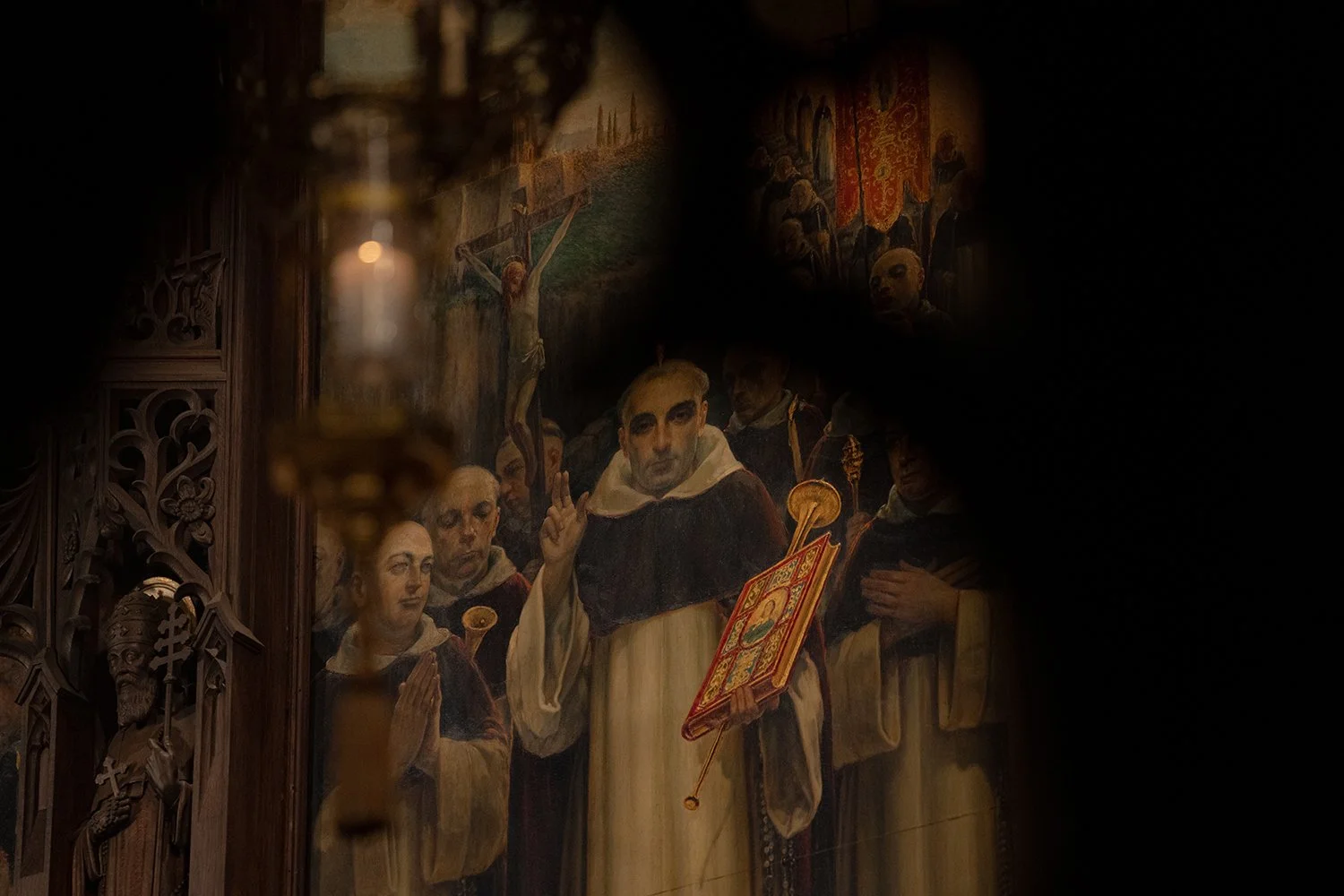
Contemporary evidence pictures St. Vincent Ferrer to have been a man of medium height, with a lofty forehead and very distinct features that seemed to inspire a sense of reverence and awe in all who knew him. His hair was fair in color and shaven in the form of a monastic tonsure, which is said to have resembled an areola of glory around his head. His eyes were very dark, very expressive, and full of fire, which were tempered, however, by his ever gentle manner. Pale as was his ordinary color, it is said that he became slightly ruddy when preaching. Although his handsomeness faded in later years as a result of his arduous labors and the austerities that he practiced, it became changed rather than vanished. His countenance took on a transparent peacefulness or glow that seemed to be the reflection of the inward beauty of his great spirit that was aflame with the love of God and of his neighbor. His voice was strong and powerful, at times gentle, resonant, and vibrant as it seemed to search the heart deeply and to inspire fear when fear was needed and to soothe with exquisite tenderness when comfort was needed.
St. Vincent Ferrer, the second son and fourth child of William Ferrer and Constance Miguel, was born in Valencia, Spain, on January 23, 1350. He was baptized the same day in the Church of St. Stephen and was named after St. Vincent Martyr, the patron saint of Valencia, a name that proved to be a prophetic one.
Vincent’s birth was anything but a quiet affair! It is said that his mother, who was accustomed to difficult pregnancies, experienced only an indescribable goodness and joy at the birth of her son. This experience was accompanied by Vincent’s father’s dream in which a Dominican friar announced to him that his son would one day enter the Order of Preachers and that his fame would spread throughout the world. A poor blind woman, when giving thanks to the mother of the saint for alms, astounded her by prophesying, “O happy mother, it is an angel that you bear, and one day he will give me my sight!” It is recorded that the woman did receive her sight.
From his cradle it seemed that, in a very special way, the hand of God rested on Vincent Ferrer, who received the gift of miracles on the same day that he received the grace of Baptism. There are many remarkable cures and healings attributed to him at an early age.
Ever mindful of the extraordinary circumstance of his birth, the young Vincent was carefully watched over by his solicitous parents. The influence of his uniquely Christian home and environment supported and encouraged the special gifts he received form God. The word and example of his parents played a large part in Vincent’s formation. It was natural then that this compassion for the poor was also conspicuous in Vincent from an early age and in large part influenced all of his life. This is better told from an excerpt from one of his sermons on love of the poor.
As the mother of Master Vincent taught her son, alms must be given with compassion, for Christ came to Jerusalem to bestow the alms of His teaching and His works of mercy, both spiritual and corporal, by healing sinners and the sick. It is a far greater mercy to give his sight to a poor blind man than a florin. Now Christ was first moved by compassion, for seeing the city, He wept over it. Thus he taught the rich that they ought to give alms to the poor in spirit by compassionating their poverty and need before they bestow temporal alms.
This is the second reason why Christ wept over Jerusalem, for He knew how many were poor in the righteousness of their lives, poor in holiness, and poor in devotion. He knew likewise how many were poor in health, poor in sight, hearing, and speech. And so He compassionated before healing. A penny given in this way, with compassion, is worth far more than a florin given from the purse only and not from the heart.
At an early age, Vincent showed remarkable intellectual talents, easily surpassing his classmates in his studies. He began his classical studies at eight years of age and finished his philosophy and theology when he was but fourteen.
He was not, however, a cold intellectual, but possessed a graceful innocence and happy disposition that endeared him to all. This purity of spirit nurtured his sense of beauty. He loved the beauties of nature, especially the countryside and the sea, for in all of nature he related to the love of his Creator.
When Vincent was eighteen, he decided to enter the Order of St. Dominic. He was clothed with the Dominican habit on Sunday, February 5, 1367. Vincent’s great love for St. Dominic led him to become well acquainted with the saint’s life, so that he might imitate, as far as possible, the virtues of that great saint. Like Dominic, he sealed himself with the mark of the crucified by a life of rigid mortification and penance. He was especially impressed by St. Dominic’s love of sacred learning, and after Vincent’s profession, he gave himself with great earnestness to the study of theology and to reading the Holy Scriptures, so that he, too, might become a preacher of the Gospel as was St. Dominic.
One of the greatest lessons Vincent learned from St. Dominic was a love of the Holy Scriptures. He studied these with great diligence until he knew them almost by heart, and could quote them on occasion. Vincent did not have time for idleness, since his time was well divided between prayer, study, and his duties as a Dominican. The priory records tell us of his unfeigned humility, his tireless prayers, and his somewhat severe but affable manner that characterized his young years in the novitiate.
After solemn profession, Vincent studied at Taragona and two years later was appointed Lector of Philosophy by the Chapter held in Valencia. After a time, he continued his course in Scripture and Hebrew in Barcelona. It was here in Barcelona that the first instance is recorded of that gift of prophecy for which afterwards he became so remarkable.
The saint, while yet a deacon, made an astounding prophecy, when in the course of a sermon, he told a starving people that by nightfall the long-looked-for relief would surely arrive. Though he was severely censured by his superiors for this statement, his words came true. This was one of many occasions in Vincent’s life when the spirit of prophecy came upon him and he foretold future events that were fulfilled. St. Vincent foretold his own canonization at the hands of Alphonsus Borgia, the future Pope Calixtus III.
Vincent was ordained to the priesthood in 1379. After receiving his degree of Doctor or Master of Theology in 1384, he returned to the convent in Valencia. A few days after Vincent’s arrival, the bishop, together with many city magistrates, begged him to give public lectures on Scripture and theology. Having obtained the leave of his provincial, Vincent at once began to lecture on theological subjects, and also to preach the Word of God to the people. He continued this work for at least six years with great success. His fame traveled far and wide and many came to hear the words of wisdom from this great preacher.
National Shrine of St. Vincent Ferrer
(Located inside the Church of St. Vincent Ferrer)
869 Lexington Avenue
New York, NY 10065
Hours:
Daily
7 AM - 7 PM
Always check the website for updates